I make my worst decisions when I’m in one of these states.
We all think we’re acting rationally. In reality, judgment is deeply shaped by how we feel at the moment of choice. Certain emotional and physical states quietly impact our reasoning. Not all emotions are dangerous in themselves, but deciding while under their influence certainly is.
I stumbled upon the HALT framework accidentally. Hungry, Angry, Lonely, Tired – four states proposed by Sanjay Bhattacharya that offer a simple lens for recognizing when judgment is compromised. HALT is not a theory of behavior or a self-improvement tool. It’s a reminder to pause when internal conditions are unreliable.
Over time, I found the framework accurate but incomplete for my personality. I added one more state, E for Excited, and changed HALT to HALTE. I made this as my personal rule for knowing when not to decide.
When I’m excited, the idea feels vivid, momentum builds, and saying yes feels like progress. This took me years to notice. I kept reviewing bad investment decisions, expecting to find fear or ignorance. What I found instead was enthusiasm mistaken for clarity.
Hungry – Hunger is scarcity.
Not limited to food – it includes money, time, security, and external validation. When scarcity is present, urgency overtakes patience. Decisions stop being about what’s right and become about what works now.
Hungry decisions look practical, but they are usually short-sighted.
Angry – Anger narrows the frame.
The decision stops being about outcomes. It becomes about proving a point, restoring ego, and showing my intelligence. Logic doesn’t disappear; instead, it serves the emotion.
Angry decisions feel strong, but they are rarely wise.
Lonely – Loneliness seeks connection over correctness.
When my father was undergoing surgery, I was managing it alone while my mother struggled with the complexity. I returned from a lucrative position to be with them. In that moment, the isolation of handling it solo made the decision feel obvious, and being together mattered more than anything else. Looking back with gratitude, it still feels right. But I also know loneliness was driving. I wasn’t weighing the decision.
Lonely decisions prioritize proximity over judgment.
Tired – Tiredness (I’m referring to tired mind) wants closure.
This usually happens after a long and hectic week. A fatigued mind skips details, accepts assumptions, and mistakes familiarity for truth. The desire to finish overtakes the need to verify.
Tired decisions aren’t careless. They’re incomplete.
Excited – Excitement is the state I find most dangerous.
Unlike hunger or anger, excitement feels positive, energizing, and builds confidence. When I’m excited, I say yes too early. I underestimate risk because the narrative feels right. Most poor investments aren’t made in fear. They are made during enthusiasm.
Excitement turns optimism into certainty and certainty into error.
The Rule
HALTE isn’t about making better decisions. It’s about knowing when not to decide.
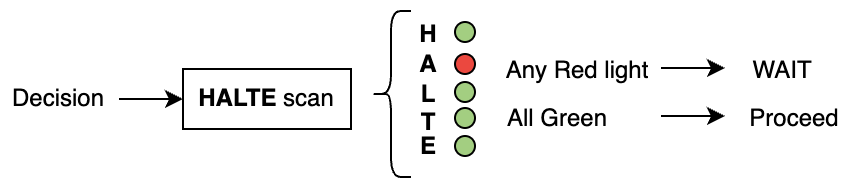
Before any significant decision, I run this scan. If I’m in a HALTE state, I pause. The decision may still be sound and appropriate, but my state is not reliable based on my experience.
This framework is a simple filter: we are rational only when we are emotionally neutral.
Why this Matters:
In this fast-paced world, Intensity, speed, and decisiveness get rewarded. Pausing is often mistaken for hesitation and as a sign of being less confident. Being perceived as fast is praised. Restraint is rarely valued by anyone.
HALTE brings balance back. It reminds me that wisdom often lies in waiting until hunger fades, anger cools, loneliness lifts, fatigue passes, and excitement settles. Only then does judgment return.
Most of my bad decisions happened when I acted under one of these states. I still fail at this. Looking back, I can see what went wrong, and naming the pattern made it obvious.
What helps me Pause:
People around me can vouch that I simply write everything. Writing helps me with clear thinking. When I catch a HALTE state, I write what I’m feeling in a journal. It is not to solve it, just to acknowledge it exists. The reactive impulse is still there, but naming it creates distance.
For decisions that feel urgent, I stay silent and wait, reminding myself that everyone operates from different assumptions and understandings. What feels right to me may look different tomorrow.
I give it overnight. Sometimes two days. I don’t know if this is the “right” waiting period, but the number of emotional decisions has dropped significantly. I track these patterns in my journal as a daily emotional tracker to see where judgment slips.
It’s not a perfect system. But it works more often than it fails.
HALTE is a checklist that tells me when my thinking can’t be trusted, even when I’m most certain.