
I’m conceptualizing a fictional financial management App called “Savr,” with the tagline “Simplify your Spend, Amplify your Savings.” Creating a financial management app for the Indian market requires a deep understanding of user needs and the technical landscape. This post explores the architecture, tech stack, cost considerations, and sample code structure for building a single-page budgeting app tailored for India.
1. Understanding the India Market for Personal Finance Apps
India’s financial technology ecosystem has snowballed, driven by UPI adoption, open banking, and the Account Aggregator (AA) framework. Unlike the U.S., where consumer credit is more widely available and adopted, the Indian market focuses more on savings, fixed deposits, and expense tracking. Any financial management tool developed here must connect to banks via India’s Account Aggregator, support varied spending patterns, and provide features like savings goal tracking and expense categorization, all while maintaining a seamless user experience.
2. Architectural Overview
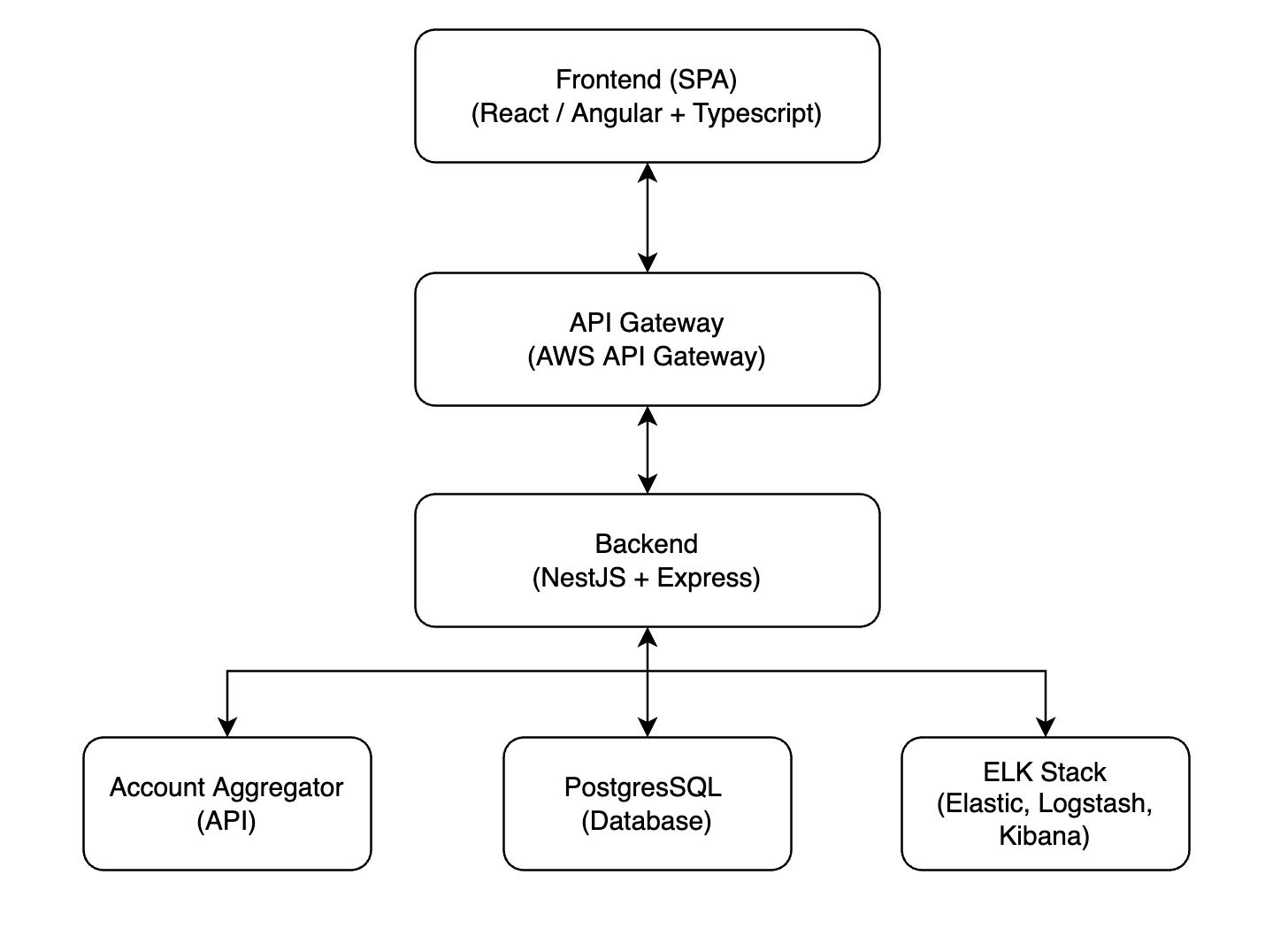
This app’s architecture must be designed to scale with user demand while ensuring smooth integration with India’s Account Aggregator framework, which allows for secure, real-time data sharing across financial institutions. Below is an architectural block diagram that represents this setup:
Block Diagram of Architecture
3. Technology Stack
Selecting a tech stack for a financial application requires a balance of performance, security, and scalability. The following stack is optimized for these considerations:
• Frontend: React or Angular with TypeScript to provide a robust single-page application (SPA) experience.
• Backend: Node.js with NestJS, a progressive Node.js framework, ensures a modular and maintainable structure.
• Database: PostgreSQL, a robust relational database, is ideal for handling financial transactions and securely storing user data.
• Account Aggregator Integration: API integration with the Account Aggregator ecosystem to securely fetch and analyze user financial data.
• Logging and Monitoring: ELK Stack (Elasticsearch, Logstash, and Kibana) for real-time monitoring, error tracking, and insights into app usage.
• Infrastructure: Hosted on AWS, leveraging services like AWS API Gateway for secure, scalable routing.
4. Backend Code Structure with NestJS
Organizing the code structure modularly enhances maintainability, scalability, and testability. Below is a suggested folder structure for the backend using NestJS:
src/
├── app.module.ts # Root module
├── main.ts # Entry point
│
├── common/ # Shared resources
│ ├── decorators/ # Custom decorators
│ ├── dtos/ # Data Transfer Objects
│ ├── filters/ # Exception filters
│ ├── guards/ # Auth and permission guards
│ ├── interceptors/ # Interceptors (e.g., logging, transform)
│ └── utils/ # Utility functions
│
├── config/ # Application configuration files
│ ├── database.config.ts # Database configuration
│ ├── app.config.ts # General app configuration
│ └── logging.config.ts # Logging config for ELK
│
├── modules/ # Core application modules
│ ├── auth/ # Authentication module
│ │ ├── auth.controller.ts # Handles authentication requests
│ │ ├── auth.service.ts # Auth logic (JWE, OAuth)
│ │ ├── auth.module.ts # Auth module definition
│ │ └── strategies/ # Strategies (e.g., JWE, OAuth2)
│ │
│ ├── user/ # User module
│ │ ├── user.controller.ts # User-related endpoints
│ │ ├── user.service.ts # User-related business logic
│ │ ├── user.module.ts # User module definition
│ │ └── entities/ # User entities and interfaces
│ │
│ ├── budget/ # Budget module
│ │ ├── budget.controller.ts # Budget-related endpoints
│ │ ├── budget.service.ts # Budget-related business logic
│ │ ├── budget.module.ts # Budget module definition
│ │ └── dtos/ # Budget-specific DTOs
│ │
│ ├── transaction/ # Transaction module
│ │ ├── transaction.controller.ts # Transaction endpoints
│ │ ├── transaction.service.ts # Transaction logic
│ │ ├── transaction.module.ts # Transaction module definition
│ │ └── entities/ # Transaction entities and interfaces
│ │
│ └── account-aggregator/ # Account Aggregator module
│ ├── aggregator.controller.ts # External API handling
│ ├── aggregator.service.ts # Aggregator business logic
│ ├── aggregator.module.ts # Aggregator module definition
│ └── dtos/ # DTOs for aggregator
│
├── database/ # Database connection and migration files
│ ├── migrations/ # Migration files for PostgreSQL
│ ├── seeds/ # Seed data for initial setup
│ └── database.module.ts # Database connection config
│
├── logging/ # Logging configuration and middleware
│ ├── elk.middleware.ts # Middleware for ELK integration
│ └── logging.module.ts # Logging module definition
│
└── test/ # Unit and e2e tests
├── e2e/ # End-to-end tests
└── unit/ # Unit tests for modules and services
Folder Structure Explanation
• src/common/: Contains reusable components like custom decorators, DTOs, exception filters, and guards for authentication and permissions.
• src/config/: Houses configuration files that can be modified according to different environments (e.g., development, production). Includes database, logging, and application configurations.
• src/modules/: Contains all core business logic organized in modules. Each module has its controller, service, and optional entities, interfaces, or DTOs:
• auth/: Authentication and authorization, including JWE strategies and OAuth integrations.
• user/: User management, profile data, and related functionalities.
• budget/: Handles budgeting features and endpoints.
• transaction/: Manages transactions, importing data from account aggregators.
• account-aggregator/: Dedicated to handling API calls and processing data from the account aggregator.
• src/database/: Database configuration and migrations. It contains a database.module.ts for handling the connection to PostgreSQL.
• src/logging/: Integrates logging middleware for ELK, ensuring logs are correctly routed to Elasticsearch.
• src/test/: Testing directory for unit and end-to-end tests. Each module can have its own set of tests to ensure complete coverage.
5. Additional Design, Cost, and Testing Considerations:
Frontend Enhancement
- Responsive layout using Tailwind CSS
- Integration with recharts for financial visualization
- Card-based UI for critical metrics
- Use of shadcn/ui components for consistent styling
Security Considerations
- Add rate limiting on the API Gateway to prevent brute force attacks
- Implement JWE (JSON Web Encryption) instead of just JWTs for sensitive financial data
- Consider adding an API security layer like AWS WAF
- Implement encryption at rest for the PostgreSQL database
Performance Optimizations
- Add Redis caching layer for frequently accessed data
- Implement database query optimization with proper indexing
- Use AWS CloudFront for static asset delivery
- Consider implementing GraphQL for more efficient data fetching
Additional Technical Components
- Add WebSocket support for real-time transaction updates
- Implement a message queue (like Amazon SQS) for asynchronous processing
- Consider adding Elasticsearch for advanced search capabilities
- Implement feature flags for gradual rollouts
Cost Optimization
- Consider using AWS Savings Plans for EC2 instances
- Implement auto-scaling based on usage patterns
- Use Amazon Aurora Serverless for the database to optimize costs
- Implement proper CloudWatch alarms for cost monitoring
Testing Strategy
- Add end-to-end testing using Cypress
- Implement performance testing using k6
- Add security scanning in the CI/CD pipeline
- Include accessibility testing
6. Cost Structure: Monthly and Annual Estimate
Let’s assume a 10,000 monthly active users (MAU) base with 500 concurrent users at peak. Here’s a rough cost breakdown on AWS:
| Component | Estimated Monthly Cost | Annual Cost |
| EC2 Instances (Backend) | $200 | $2400 |
| RDS (PostgresSQL) | $150 | $1,800 |
| API Gateway | $50 | $600 |
| ELK Stack | $100 | $1200 |
| S3 for Backups | $20 | $240 |
| Account Aggregator | $100 | $1200 |
| Total Estimated Cost | $620 | $7,440 |
7. Engineering Team Structure
Using full-stack engineers can streamline development, as they can handle both frontend and backend tasks, reducing the need for specialization across different roles. Here’s a proposed team composition for building this budgeting app:
- Full-Stack Engineers (4-5): Skilled in React (or Angular) for frontend and Node.js with NestJS for backend. These engineers can work across modules, from user authentication to transaction handling and integrations with the Account Aggregator framework.
- DevOps Engineer (1): Responsible for AWS setup, infrastructure automation, CI/CD pipelines, and monitoring setup with ELK Stack.
- Product Manager (1): Works with stakeholders to refine app requirements, prioritize features, and ensure alignment with user needs in the Indian market.
- UX/UI Designer (1): Crafts a user-friendly interface, focusing on localization and usability tailored to the Indian audience.
With this team of around 7-8 people leveraging full-stack engineers, development can proceed more agilely and iteratively. This streamlined team can handle both development and deployment efficiently while ensuring cross-functional collaboration.
8. Conclusion
Building a budgeting app for the Indian market involves more than a sleek UI; it requires a robust architecture, seamless integration with India’s financial APIs, and a cost-effective infrastructure setup. A development team can efficiently manage, scale, and maintain the app by following this architecture and code structure, ensuring a smooth user experience. With this foundation, you’re well on your way to creating a solution that simplifies financial management for millions.