“Trust doesn’t collapse from one catastrophic decision. It drains away through accumulated contradictions: i.e., the small signals that leadership says and leadership does operate on different tracks.
I have watched this pattern across firms in India, the USA, and Europe. The industries change. The symptoms change, but the core reasoning remains the same: employees can’t get clear direction, and when things go wrong, leadership won’t own it.
1. The Behaviors That Quietly Erode Trust
Trust doesn’t collapse from one mistake, but by small 100s of actions every day that signal misalignment between intent and action.
Intent: In a corporate hierarchy, most employees may not understand market dynamics or strategic trade-offs, but they have the intuition to distinguish between personal ambition and long-term benefits to the organization. When true intent isn’t aligned with the larger benefit, trust in management erodes slowly.
Consistency: Leaders are great communicators. They are so convincing that everyone in the organization follows through, but credibility is not built on excellent communication; instead, it is built on the consistency of their actions. Inconsistency is evident in small meetings, where the true intent is clearly apparent. Over time, people stop listening but show external support. For example, Priority shift without context: urgency appears, then disappears, then reappears again for no good reason.
Externalize Blame: Character is revealed when things go wrong. Leaders who externalize failure while internalizing success send a signal that it is okay to blame external factors such as other teams, competitions, the market, or legacy systems/decisions. Employees have an innate ability to recognize asymmetry, which deepens mistrust.
Exclusivity: Organizations call people above specific designations’ leaders’ and start treating them like members of exclusive circles. Farther from ground reality, the people in that exclusive club live in a bubble.
Empathy: When words don’t carry true intent, they feel hollow. Empathy is most visible in micro decisions, such as shielding the team from chaos and acknowledging accountability when outcomes fail.
Instability amplifies everything. Large reorganizations without a coherent explanation fracture trust deeply. When rationale reverses within months, competence and authenticity are questioned simultaneously. People do not resist change. They resist incoherence.
2. The Underlying Cause: Fear as the Hidden Driver
Most leadership failures don’t originate from lack of skill but from unexamined fear. Fear manifests as a reactive strategy, and decisions are made only after observing competitors’ moves. Charlie Munger identified this pattern in The Psychology of Human Misjudgment: top executives mimic one another with immature urgency, not out of conviction, but to avoid being wrong alone.
The logic is straightforward. If my decision fails, others will magnify my shortcomings. If I copy and fail alongside peers, the exposure feels survivable. Fear of appearing incompetent. Fear of losing relevance. Fear of making irreversible mistakes. Fear of exclusion. Imitation becomes a shield, not a strategy. It signals doubt and kills originality. The only exception: when “fast follower” is an intentional, declared choice and not a shield for insecurity.
Leaders rarely recognize this transformation in themselves. Employees observe their behavior and draw their own conclusions. Though leaders believe they are responding to complexity but employees experience inconsistency. This asymmetry is the root of the problem and creates distance. Over time, the gap between leaders’ beliefs about who they are and how they are perceived widens quietly until trust becomes fragile.
3. The Difficult Question: Am I Willing to Lead Differently?
Confronting these patterns raised an uncomfortable question: if I’m expecting leadership grounded in clarity and courage, am I prepared to embody it consistently?
The answer is still evolving. Insecurities do not disappear. Imposter syndrome still resurfaces. Decisions are occasionally shaped by anxiety rather than conviction. What has changed is frequency and awareness. Fear-driven behavior occurs less often. Clarity recovers faster. The direction of movement matters.
A meaningful shift occurred when I stopped seeking recognition. Detaching from titles, visibility, and validation reduced internal noise. This was not transcendence. It was alignment. When the need to perform diminishes, authenticity has space to emerge. Leadership becomes less about image and more about coherence between words and actions.
Observing this transformation in myself clarified something about the above behaviors. They weren’t random failures. They are clustered around two fundamental choices every leader makes constantly: how you manage ambiguity for your team and how you handle accountability when outcomes arrive. They may seem different, but these aren’t separate skills. They are dimensions that systematically interact to either build or destroy trust.
That pattern became a framework.
The Leadership Matrix: How Trust Is Systematically Created or Destroyed
Leadership operates on two dimensions: how you manage ambiguity and how you handle accountability.
- Ambiguity Management separates leaders from others. You convert chaos into actionable clarity. You may be 60% confident, but your team receives clear direction. The alternative is pushing anxiety downward.
- Accountability is the key leadership trait. Success flows to the team, but failure stays with you. No performance statements crafted by communications teams.
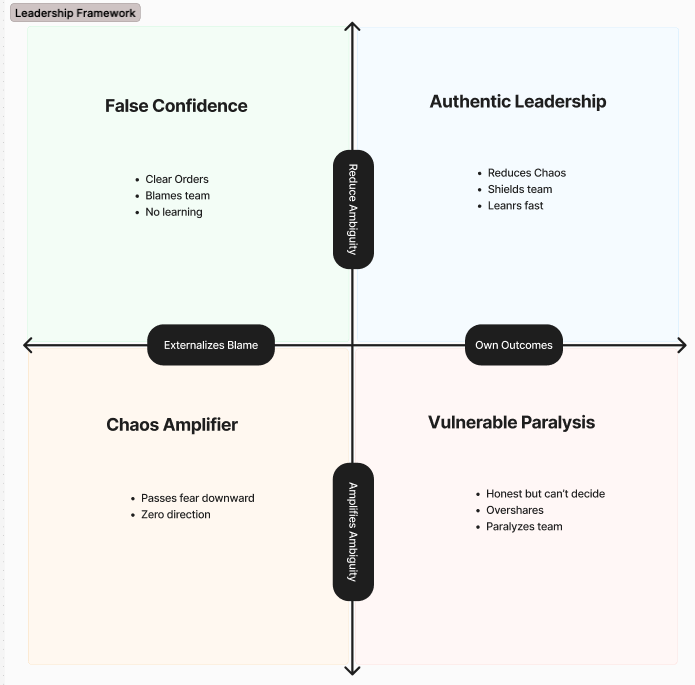
Authentic Leadership (top right) compresses ambiguity while completely owning outcomes. Say-do consistency remains high. Trust compounds. It requires a willingness to make clear decisions despite uncertainty and the courage to own results without deflection.
False Confidence (top left) gives clear direction and compresses ambiguity well. But when outcomes fail, blame shifts to market conditions, team execution, and legacy decisions. These leaders appear decisive, but they systematically erode trust. This is the most dangerous territory, creating toxic cultures.
Vulnerable Paralysis (bottom right) displays honesty about uncertainty and willingness to own outcomes, but cannot compress ambiguity into a clear action. Oversharing anxiety paralyzes teams, though their respect exists, but confidence drains.
Chaos Amplifier (bottom left) dumps anxiety on teams while taking no responsibility. Pure abdication. Maximum damage. Trust collapses immediately.
Most leaders get stuck in False Confidence. They compress ambiguity effectively and appear strong. But externalizing blame breaks the key leadership requirement. This creates high-output teams with low trust and brittle cultures that crack under pressure.
The pattern I observe most, including in myself, is movement from False Confidence toward Authentic Leadership through self-awareness. Witnessing fear-driven blame patterns before they distort our own behavior.
What I’m Working Toward
I stopped aspiring to be the leader with all the answers.
What I’m working toward instead: Confidence without needing external validation, decisions from conviction, not competitive anxiety. Jensen Huang’s distinction landed: perspective is inclusive, vision is exclusive. I want to lead from perspective – bringing people into understanding rather than expecting them to follow a singular vision they don’t share.
This means understanding my insecurities instead of projecting them. Making fewer decisions out of fear. Letting actions carry more weight than vocabulary. Becoming someone whose intent reads clearly, whose behavior stays consistent, whose presence encourages trust rather than demanding it.
Leadership is closing the distance between who you believe you are and who you actually are. Trust builds or erodes in that gap. The work continues. The distance shrinks.
Part of my larger exploration of leadership. My experiences with wartime leadership, ownership, and depth of engagement shaped the trust framework I describe here.